Your furnace slot holds a 4-inch filter for a reason. That depth gives you roughly four times the filter media of a standard 1-inch version at the same face size, which means better particle capture, less strain on your blower motor, and a change interval you measure in months rather than weeks.
Filterbuy has manufactured the 11.25x19.25x4 in the USA since 2013. It's not an obscure size we occasionally stock. We build it every day in our own facilities in Alabama, Florida, Pennsylvania, and Utah, and ship it factory-direct to homes across the country.
Pets, seasonal allergies, cooking smoke, or a hard-working HVAC system that just needs a clean filter: whatever brought you here, getting the right 11.25x19.25x4 air filter makes a daily difference in the air your family breathes.
TL;DR — Quick Answers
11.25x19.25x4 Air Filters
What is an 11.25x19.25x4 air filter? A standard residential HVAC filter — 11.25" wide, 19.25" tall, 4" deep — built for furnaces and air handlers with a 4-inch filter slot. Available from Filterbuy in MERV 8, MERV 11, and MERV 13.
Which MERV rating do I need?
MERV 8 — dust, pollen, mold spores; most homes
MERV 11 — adds pet dander and smoke; pets or mild allergies
MERV 13 — bacteria, virus carriers, ultrafine particles; allergy and asthma households
How often should I change it? Every 3 to 6 months. Pets, smokers, or allergy sufferers: every 3 months. Low-traffic homes: up to 6 months. Inspect quarterly and change when it looks gray.
Why does the 4-inch depth matter? It holds roughly four times the filter media of a 1-inch version — longer filter life, better particle capture, and less strain on the blower motor.
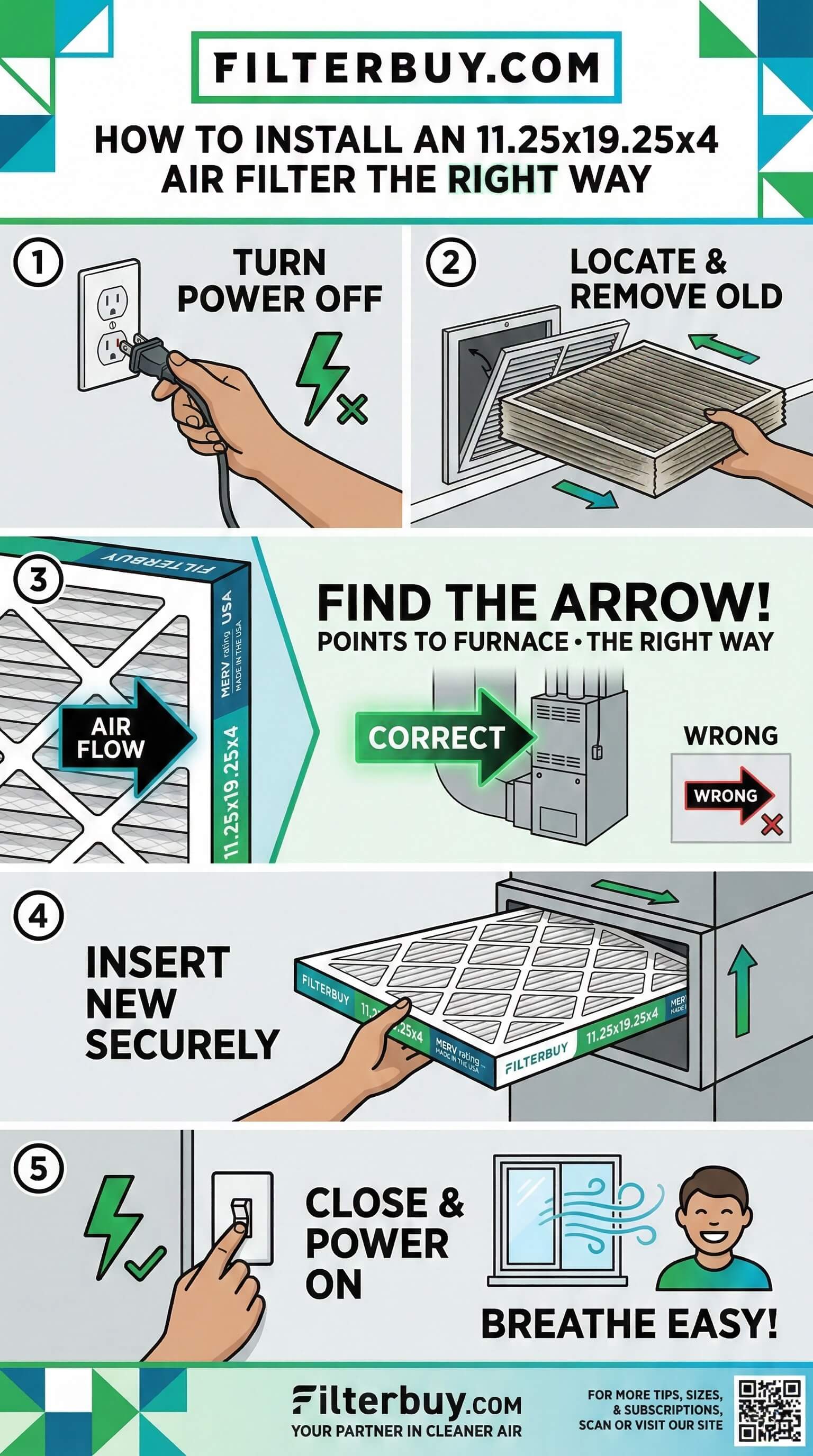
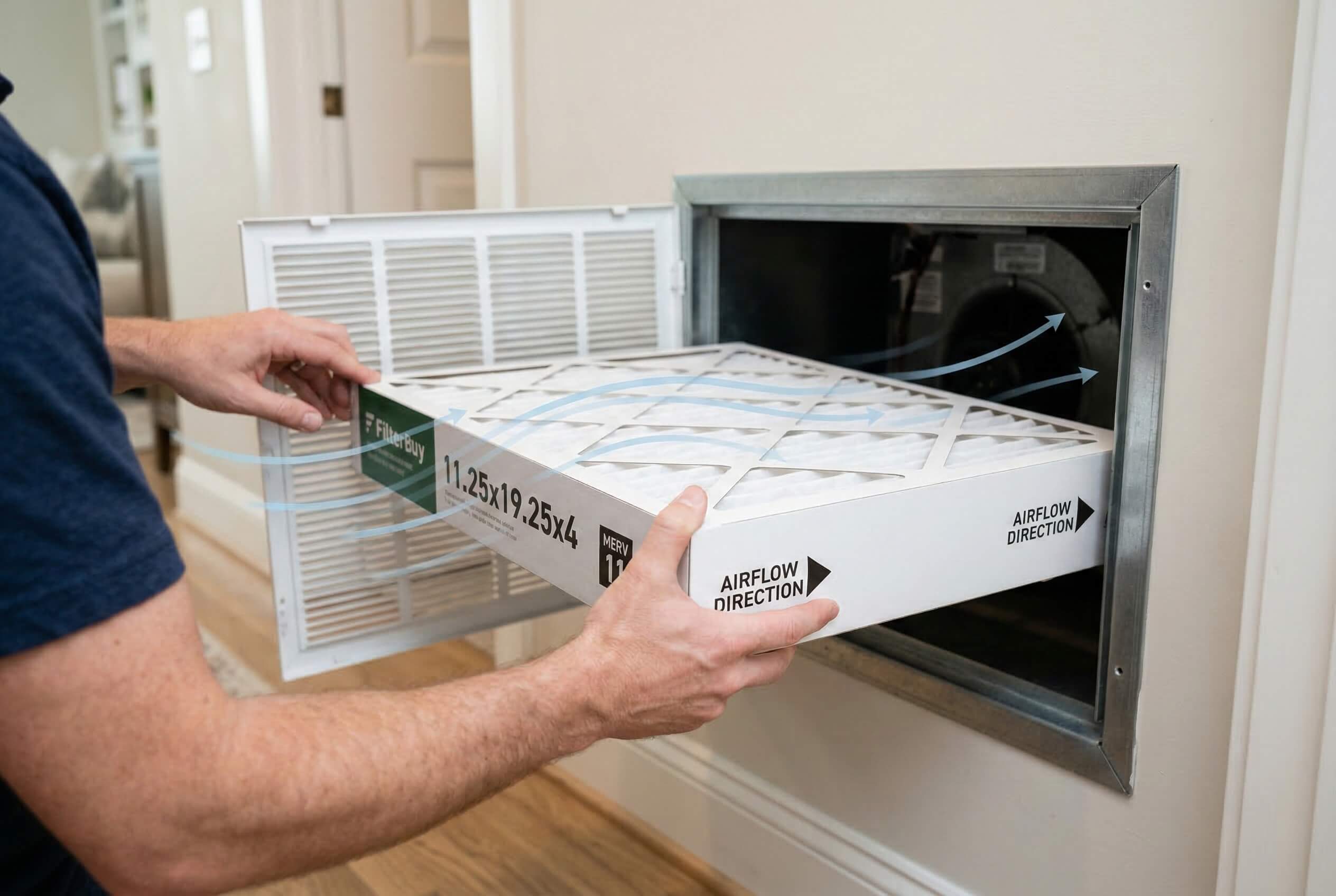
How do I install it? Turn off the system. Slide out the old filter. Insert the new one with the airflow arrow pointing toward the blower motor. Replace the panel. Restart. Under 5 minutes.
Where can I buy an 11.25x19.25x4 air filter? Filterbuy ships all three MERV ratings factory-direct with free shipping. Big-box stores carry this size inconsistently.
Top Takeaways
• Your 11.25x19.25x4 filter slot is a performance asset. The 4-inch depth gives you longer filter life and higher MERV efficiency than standard 1-inch filters. Take advantage of it.
• MERV rating matters more than most people think. MERV 8 for basic protection, MERV 11 for pets and mild allergies, MERV 13 for maximum air quality and respiratory health.
• Change schedule depends on your household, not just the calendar. Pets, smokers, kids, and high-traffic homes need changes closer to every 3 months. Low-activity homes may go 6 months. Inspect quarterly.
• Airflow direction is non-negotiable. Always install with the arrow on the filter frame pointing toward your blower motor. Installing it backwards reduces effectiveness and stresses your system.
• Factory-direct means better value. Buying from Filterbuy means paying the manufacturing price, not the big-box markup, with free shipping and American-made quality.
• Indoor air is often more polluted than outdoor air. According to the EPA, indoor pollutant concentrations can run 2 to 5 times higher than outdoors. Your filter is your primary defense against that.
• Auto-delivery removes the biggest risk in home air quality: forgetting to change the filter. The filter that never gets changed doesn't protect anyone. Set it up once, and Filterbuy ships your exact size right when you need it.
What Makes the 11.25x19.25x4 Air Filter Different
Most homeowners pick a filter based on what fits the slot. The depth of that slot is worth a closer look.
The 4-Inch Advantage
The 4-inch filter in your 11.25x19.25x4 slot holds roughly four times the filter media of a 1-inch version at the same face dimensions. That media is where filtration actually happens. More of it means:
• Higher particle capture capacity before airflow starts to restrict
• Longer service life, typically 3 to 6 months versus 1 to 3 months for 1-inch filters at the same MERV rating
• Lower pressure drop over time, which reduces wear on your HVAC blower motor
• Better filtration efficiency at equivalent MERV ratings compared to thinner filters
Choosing Your MERV Rating: The Quick Guide
MERV (Minimum Efficiency Reporting Value) is the scale that tells you how fine the particles are that a filter catches. Filterbuy makes the 11.25x19.25x4 in three MERV ratings. Here's how to match one to your home:
MERV 8
Best for: Most homes — everyday filtration.
Captures: Dust, pollen, mold spores, and dust mite debris.
MERV 11
Best for: Homes with pets or mild allergies.
Captures: Everything MERV 8 catches, plus pet dander, fine lint, and smoke particles.
MERV 13
Best for: Allergy and asthma households, maximum air quality.
Captures: Everything above, plus bacteria, virus carriers, and ultrafine particles.
The Filterbuy Difference: Factory-Direct, American-Made
Order the 11.25x19.25x4 at a big-box store, and you're paying for real estate, stocking costs, and supply chain markups. You might also get a filter manufactured overseas to whatever quality standard the retailer's supplier chose that quarter.
Filterbuy builds this filter in our own plants in Alabama, Florida, Pennsylvania, and Utah. Every order goes from our production floor directly to your front door: no middlemen, no markups, free shipping on every order. Bulk pricing applies to multi-packs, and auto-delivery handles the scheduling if you'd rather set it and forget it.
The 11.25x19.25x4 is not a size we scramble to source. We make it ourselves, every day.
The biggest mistake homeowners make with a 4-inch filter like the 11.25x19.25x4 is treating it like a 1-inch filter—changing it every 30 days out of habit, or leaving it in too long because it "looks fine." A 4-inch filter is designed for a 3-to-6-month cycle, but that window shifts based on your household: pets, smokers, kids, and proximity to a busy road all accelerate particulate loading, so let your environment drive your change schedule, not just a calendar reminder. On MERV rating, step up one level above what you think you need—after a decade-plus in this industry, I've seen how much particulate matter circulates in the average home that the naked eye doesn't register, and if you're breathing that air 8–12 hours a night, a MERV 11 or 13 is an investment in your family's health, not overkill. And don't overlook airflow direction: always match the arrow on the filter frame to the direction air flows toward your blower motor, or you're undermining the entire system.
— Senior Air Quality Engineer, Filterbuy Manufacturing
7 Essential Resources for Air Filter Education
These are the sources our air quality team actually uses when building filtration standards and answering customer questions. Worth bookmarking.
1. EPA — Indoor Air Quality (IAQ) | U.S. Environmental Protection Agency
The EPA's indoor air quality hub covers common indoor pollutants, their health effects, ventilation standards, and filtration guidance, written for homeowners rather than engineers. If you want to understand why your air filter matters beyond the obvious, start here.
2. Wikipedia — Air Filter Overview | Reference-level overview of filter types and standards
A solid starting point for understanding how air filters work, from mechanical filtration principles to HEPA and MERV classification systems. Good for homeowners who want the foundational science without reading through a full technical standard.
3. ASHRAE — HVAC Filtration Standards (ANSI/ASHRAE 52.2) | American Society of Heating, Refrigerating and Air-Conditioning Engineers
ASHRAE Standard 52.2 is the definitive technical standard that established the MERV rating system. This is where MERV ratings come from and where the industry benchmarks filter performance. If you want to go deep on how filters are tested and certified, this is the primary source.
4. CDC — Indoor Environmental Quality | National Institute for Occupational Safety and Health
The CDC's NIOSH resource approaches air quality from a public health angle, covering ventilation, air contaminants, biological agents, and the health consequences of inadequate filtration. Especially relevant for households with immunocompromised individuals or respiratory conditions.
5. U.S. Department of Energy — Heating & Cooling Efficiency | Office of Energy Efficiency & Renewable Energy
The DOE's Energy Saver resource explains how HVAC systems consume energy and how routine maintenance, including regular filter replacement, directly affects system efficiency and monthly utility bills. A clogged 11.25x19.25x4 filter doesn't just hurt your air quality. It costs you money.
6. ENERGY STAR — HVAC System Guidance | U.S. EPA ENERGY STAR Program
ENERGY STAR's HVAC section covers equipment efficiency ratings, maintenance schedules, and the role of air filtration in keeping a system running at spec. Worth reading if you're shopping for high-efficiency HVAC equipment and want to understand how your filter choice connects to the system's performance targets.
7. American Lung Association — Indoor Air Quality Resources | Health-focused guidance from a leading respiratory health authority
The American Lung Association covers air quality through a respiratory health lens, which makes it especially useful for households with asthma, allergies, or young kids. Their guidance makes a clear case for upgrading to MERV 11 or MERV 13 filtration.
3 Statistics Worth Knowing Before Your Next Filter Change
Three numbers that put the air inside your home in context.
Americans spend about 90% of their time indoors, where concentrations of some pollutants run 2 to 5 times higher than outdoor levels.
Source: U.S. Environmental Protection Agency — Indoor Air Quality Report
What this means at home: Your home is where nearly all of your air intake happens. Running an overdue or undersized filter means breathing air that's measurably dirtier than what's outside your window. The 11.25x19.25x4, with its 4-inch media bed, is built to handle exactly this kind of sustained daily load.
Heating and cooling account for close to half of all home energy use, making HVAC maintenance one of the highest-impact things you can do to control monthly utility costs.
Source: U.S. Department of Energy — Energy Saver: Heating & Cooling
What this means at home: A clogged or wrong-sized filter forces the blower motor to work against restricted airflow, which drives up energy use and shortens system life. A clean, correctly sized 11.25x19.25x4 keeps everything running the way it was designed to. The filter pays for itself in reduced energy costs well before its next replacement.
MERV 13 filters, the highest rating available in residential 4-inch sizes, capture at least 75% of particles in the 0.3 to 1.0 micron range, including bacteria, virus carriers, and combustion byproducts.
Source: ASHRAE Standard 52.2 — Method of Testing General Ventilation Air-Cleaning Devices
What this means at home: At the sub-micron level, you're not talking about dust anymore. You're talking about the particles most closely tied to respiratory illness and allergy triggers. For households with asthma, seasonal allergies, or anyone who just wants the cleanest air available, a Filterbuy 11.25x19.25x4 MERV 13 is operating at the top of what residential filtration delivers.
Final Thoughts & Our Honest Opinion
Your 11.25x19.25x4 slot is one of the better things your HVAC setup has going for it. The 4-inch depth lets you run higher MERV ratings without the pressure drop you'd get from a thinner filter at the same spec. Your system was designed to handle it. Use that.
Our honest recommendation: don't default to MERV 8 just because it's familiar or a few dollars cheaper upfront. The price difference between a Filterbuy MERV 8 and a MERV 13 in this size is modest. The difference in what those filters catch is not. Dust and pollen are visible problems. Bacteria and combustion particles aren't. We'd rather you breathe clean air you can't see than only protect against what you can.
One thing competitors rarely say out loud: the best filter you own doesn't protect anyone if it's overdue for a change. A loaded MERV 13 performs worse than a fresh MERV 8. Filtration performance drops as the media fills with captured particles. That's the real reason our auto-delivery program exists, not as an upsell, but because the single most practical thing you can do for your home's air quality is make sure the change never slips.
In over a decade of shipping filters to American households, the feedback we hear most isn't about MERV specs or dimensions. It's from parents who tell us they sleep better knowing what their kids are breathing every night. That's what 'Better Air For All' means on our manufacturing floor, not a tagline, but something we take seriously at every step of production.
Pick the right rating. Change it on schedule. And if you're undecided between MERV ratings, step up. Your air will be better for it.
Frequently Asked Questions
Your questions answered directly.
Q: What does 11.25x19.25x4 mean on an air filter?
Those three numbers are the filter's actual dimensions in inches: 11.25 wide, 19.25 tall, and 4 deep. They match the physical size of the filter slot in your furnace or air handler. Even a small gap from a slightly undersized or imprecisely cut filter lets unfiltered air bypass the media entirely, which defeats the purpose of having a filter at all. For a broader look at how air filter dimensions and standards work, the Wikipedia overview of air filters is a good reference. At Filterbuy, we manufacture to precise dimensions so your filter fits flush every time.
Q: What's the difference between MERV 8, MERV 11, and MERV 13?
MERV (Minimum Efficiency Reporting Value) is the standardized scale for measuring how finely a filter captures airborne particles. MERV 8 handles dust, pollen, and mold spores effectively and works well in most homes. MERV 11 catches everything MERV 8 does, plus pet dander, fine smoke particles, and smaller allergens, making it the right choice for homes with pets or mild respiratory sensitivities. MERV 13 is the top tier for residential use: it captures bacteria, virus-carrying particles, and ultrafine combustion byproducts, and we recommend it for anyone with asthma, allergies, or a family member with health concerns.
Q: How often should I change my 11.25x19.25x4 air filter?
Plan on every 3 to 6 months for a 4-inch depth filter like the 11.25x19.25x4. Homes with pets or smokers should change closer to every 3 months. Single-occupant, no-pet, low-dust homes can often go the full 6. A good habit: inspect the filter every 90 days. If it looks noticeably gray or loaded with debris, change it regardless of how much time has passed. Filterbuy's auto-delivery lets you set a custom delivery interval so your next filter arrives right on schedule.
Q: Is 11.25x19.25x4 a standard air filter size?
Yes, the 11.25x19.25x4 is a standard nominal size found in a wide range of residential furnaces and air handlers. That said, 'standard' doesn't mean universal. If you're replacing a filter for the first time or switching brands, measure your existing filter before ordering: length, width, and depth. Some systems are labeled with rounded nominal dimensions that don't perfectly match the actual slot size. When in doubt, measure first.
Q: Can I find this filter at Home Depot, Walmart, or Amazon?
You may find a limited selection in-store, but availability for the 11.25x19.25x4 size, particularly in MERV 13 or bulk quantities, is inconsistent at best. At Filterbuy, this is a standard stocked size available in all three MERV ratings, in single units or multi-packs, with free shipping and no minimum order. And because we manufacture factory-direct, our pricing competes with big-box retail without the middleman markups.
Q: Does the thickness of my filter (4 inches) affect performance?
Significantly. A 4-inch filter in the 11.25x19.25x4 size holds dramatically more filter media than a 1-inch filter at the same face dimensions. More media depth means more surface area for particle capture, a slower rate of pressure buildup over time, and a longer useful service life. Most systems that accept this depth were designed specifically to get the best out of it.
Q: How do I know I'm installing the filter in the right direction?
Look for the airflow direction arrow printed on the filter's cardboard frame. That arrow should always point toward your blower motor, which means it points away from the return air duct where air enters the system. Installing a filter backwards isn't immediately obvious, but it degrades performance over time by loading the fine filter fibers first instead of the coarser pre-filtration layers they're designed to protect. When in doubt: arrow toward the blower.
Q: Is there an 11.25x19.25x4 air filter available near me?
For anyone searching 'near me': Filterbuy ships nationwide with free delivery, typically arriving in 1 to 3 business days. For most homeowners, that's faster than a store run, and you get the full MERV range, bulk pricing, and auto-delivery options you won't find on a hardware store shelf.
Shop 11.25x19.25x4 Filters — Free Shipping Today
Your exact size is in stock, made in the USA, and ships free today. Pick your MERV rating and we'll handle everything else, including a reminder when your next change is due.
Learn more about HVAC Care from one of our HVAC solutions branches…
Filterbuy HVAC Solutions - Weston FL
2573 Mayfair Lane Weston FL 33327
(754) 296-3528
https://maps.app.goo.gl/E3tjmKf5VSWYghGc7